
Most manufacturing and engineering websites fall between £3,000 and £20,000, with more complex platforms reaching £20,000+.
You can spend less. You can spend more. The difference comes down to what the website is expected to do for your business.
A simple brochure site will sit at the lower end. A lead-generating platform that supports your sales team, integrates with your systems, and reflects your technical expertise will require a higher investment.
This guide breaks down what drives those costs, what you should expect at each level, and how to make a confident decision.
Why Industrial Website Costs Vary More Than You Might Expect
Industrial websites are rarely simple.
You’re often communicating complex products, long sales cycles, and technical detail to multiple decision-makers. That might include engineers, procurement teams, and directors, all looking for different information.
That complexity affects cost.
A website for a machinery manufacturer with 150 products, specification sheets, and distributor enquiries will naturally require more planning and structure than a five-page brochure site.
The key question is not just ‘how much does it cost?’, but ‘what does it need to achieve?’
Typical Cost Ranges for Manufacturing & Engineering Websites
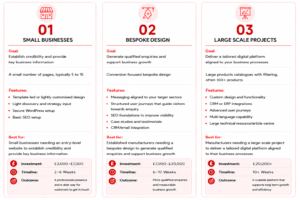
Small Businesses: £3,000–£7,000
This level usually covers a professional online presence.
You can expect:
- A small number of pages, typically 5 to 15
- Template-led or lightly customised design
- Light discovery and strategy input
- Secure WordPress setup
- Basic SEO setup
This can work if you simply need a professional online presence.
Bespoke Design: £7,000–£20,000
This is where most established industrial businesses invest.
At this level, your website is designed from the ground up and includes support for getting your messaging and user journey right.
- Conversion focused bespoke design
- Messaging aligned to your target sectors
- Structured user journeys that guide visitors towards enquiry
- SEO foundations to improve visibility
- Case studies and testimonials
- CRM/email integration
For many businesses, this is where the website starts to contribute measurable ROI.
Large Scale Projects: £20,000+
Larger or more complex organisations often need additional capability.
This may include:
- Large product catalogues, with filtering, often 100+ products
- Custom design and functionality
- CRM or ERP integrations
- Advanced user journeys
- Multi-language capability
- Large technical resource/article centre
These websites often become part of your operational infrastructure, not just your marketing.
What Actually Drives the Cost of an Industrial Website?
Two websites with the same number of pages can vary significantly in cost. The difference usually comes down to the thinking behind them.
The Discovery Process: Planning for Results
Before design begins, there needs to be clarity around:
- Your ideal customer and sectors
- How your sales process works
- What information buyers need at each stage
For manufacturing businesses, this might include mapping out how engineers research specifications, how buyers compare suppliers, and what triggers an enquiry.
This discovery phase is often the difference between a website that looks good and one that generates leads.
Design Process: Supporting Clarity, Not Just Appearance
Good design helps visitors understand what you do and take action.
For industrial websites, that means:
- Clear navigation across complex product or service ranges
- Logical page structure
- Mobile-friendly layouts
- Fast loading speeds
Design is less about decoration and more about making technical information easy to access.
Development & Integrations
The more your website connects with your internal systems, the more development is required.
Common examples include:
- CRM integration for tracking enquiries
- ERP integration for product or order data
- Integration with dealer or distributor systems
- Custom enquiry forms based on product type or application
These integrations add cost, but they often improve efficiency across your business.
Technical Content & Photography
Content plays a central role in industrial websites.
Buyers are looking for:
- Clear explanations of your capabilities
- Specification sheets and technical documentation
- Evidence you understand their application
Photography also matters more than many expect. Real images of your machinery, processes, and team build trust quickly, especially in sectors where credibility is critical.
Ongoing Support & Growth
A website is not a one-off project.
Ongoing investment often includes:
- SEO and content development
- Conversion improvements
- Performance tracking
- Technical updates and support
This is where long-term value is built.
When Should You Invest in a New Industrial Website?
Many MDs and Marketing Managers delay a new website because the current one still ‘works’.
The question is whether it’s working well enough.
Common triggers include:
- You’re getting enquiries, but they’re low quality
- Your product range has outgrown your website structure
- Your team relies on manual processes that could be automated
- Your competitors present their capabilities more clearly
- Your website doesn’t reflect your current positioning or scale
- You’re investing in SEO or ads, but conversion rates are low
If your website is slowing down sales conversations rather than supporting them, it’s usually time to review it.
How to Brief a Web Design Agency for an Accurate Quote
Accurate pricing starts with a clear brief.
You don’t need to have everything defined, but the more context you provide, the more reliable the quote will be.
At a minimum, include:
- Your goals (lead generation, sectors, growth targets)
- A rough page list or sitemap
- Details of your product or service range
- Any required integrations (CRM, ERP, portals)
- Examples of websites you like and why
This helps agencies recommend the right approach rather than guessing.
Red Flags to Watch Out for When Comparing Website Quotes
Not all quotes are built on the same assumptions.
Watch for:
- Very low pricing with little or no discovery included
- No mention of content or messaging
- Vague deliverables or unclear timelines
- A focus on design without discussion of lead generation
- No plan for SEO or performance tracking
A lower upfront cost can often lead to higher costs later if the website needs to be reworked.
How to Choose the Right Web Design Partner for an Industrial Business
Choosing the right partner has as much impact as the budget itself.
Look for:
- Experience in manufacturing, engineering, or machinery sectors
- A proven process that covers strategy, design, and development
- A focus on measurable results, not just aesthetics
- The ability to understand technical products and communicate them clearly
- Ongoing support after launch
You’re not just buying a website. You’re choosing a partner who will influence how your business is presented online for years to come.
Final Thoughts: Cost Is Only Part of the Decision
An industrial website can cost £3,000 or £20,000+.
What matters is whether it supports your business goals.
A lower-cost site may provide a basic presence. A well-planned, conversion-focused website is designed to generate consistent, qualified enquiries and support your sales team.
If your website plays a key role in growth, it’s worth approaching it as an investment rather than a one-off cost.
When you’re ready to explore what that could look like for your business, we’re here to help.
Schedule a discovery call to discuss your goals and get a clear, realistic view of the right investment for your website.